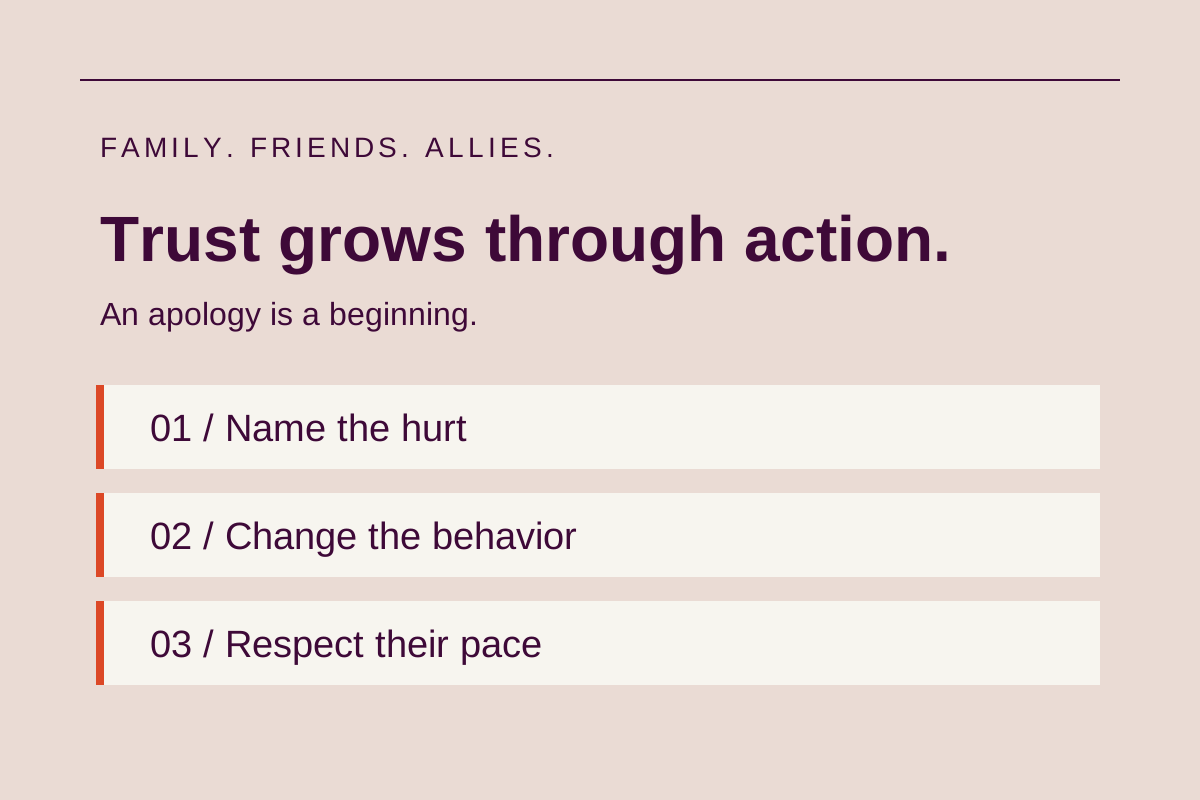
Perhaps a loved one trusted you with their identity and you responded with silence, questions that felt like an interrogation, or words you now regret. Perhaps you shared something private, excluded a partner, or made a joke that landed badly. You cannot undo the moment. You can decide what happens next. Repair begins with taking responsibility for your own behavior, without asking the hurt person to make you feel better. This guide offers a practical approach to apology and changed behavior. It does not promise forgiveness or a quick return to closeness. Your loved one gets a say in what contact, if any, feels right for them.
1. Stop the behavior before explaining it
The first act of repair is to stop doing the thing that caused harm. If you are arguing, pause the argument. If you posted private information, remove the post when you can, while recognizing that deletion may not erase what others have seen. If you invited other relatives to pressure your loved one, stop recruiting them. An apology has little room to work while the same behavior continues in another form.
Separate stopping from solving everything. You can say, “I spoke harshly. I am stopping this conversation because I do not want to keep hurting you. I want to take responsibility when you are ready.” Do not use a pause as a threat, a dramatic exit, or a way to avoid returning to the issue. If the person wants distance, respect that. If they want to finish speaking and you can listen without attacking, let them.
Notice what you are tempted to do next. You may want to send ten messages, explain your childhood, or ask another relative to put in a good word. Slow down. Those actions may relieve your anxiety while creating more work for the person you hurt. Before acting, ask, “Does this reduce the pressure on them, or increase it?” A brief, accountable message is often a more respectful beginning than a flood of emotion they did not ask to receive.
2. Name your part clearly
A useful apology identifies a behavior. “I am sorry for everything” can sound sweeping without showing that you understand what happened. Try, “I told your sister something you shared with me privately,” or “I called your relationship a phase.” You do not have to recite every detail, particularly if repeating the words would be painful. You do need to show that you are taking responsibility for something specific.
Distinguish intent from impact. You may have meant to protect, guide, comfort, or connect. That information does not cancel the effect of your words. “I was trying to help” can become a shield if it is used to end the conversation. A more accountable sentence is, “I thought I was helping, and I can see that I put my assumptions ahead of listening to you.” The word “and” allows you to acknowledge both realities without making one erase the other.
Do not make the apology depend on the other person proving that their reaction was reasonable. Statements such as “I am sorry you took it that way” place the problem in their interpretation. Start instead with what you controlled: what you said, shared, allowed, or failed to do. You can reflect later on broader relationship concerns. Your first apology should not become a list of the other person’s faults.
3. Listen without cross-examining
If your loved one wants to describe the impact, listen for understanding rather than a defense. Put down your phone. Let them finish. You can ask, “Would you like to tell me what that moment was like for you?” They may decline, and you can still take responsibility. You are not entitled to a detailed account of their pain before you change your behavior.
Reflect what you hear in ordinary language. “You were trusting me with something private, and my reaction made you feel that you had to defend yourself.” Then check, “Am I understanding?” This is different from agreeing to every interpretation of the relationship. It shows that you are trying to hear the experience you helped create. Avoid correcting small details that do not change your responsibility, such as the exact time a conversation happened.
If you become defensive, notice it before speaking. Take a breath, put your feet on the floor, or ask for a short pause with a clear plan to return, if the other person wants that. Do not require them to calm you. A sentence such as “I notice I want to defend myself, and I am going to keep listening” may be enough. If the conversation becomes insulting or threatening on either side, it is reasonable to pause and seek a safer way to communicate. Accountability does not require remaining in an unsafe exchange.
4. Offer an apology that leaves them room
A straightforward apology has four useful parts: name the action, acknowledge its effect, accept responsibility, and state what you will change. These are conversation prompts, not a formula that guarantees forgiveness. For example: “I told someone you are bisexual without asking. That took away your choice about sharing it. I was wrong to do that. I will ask before sharing personal information, and I want to follow your lead about what happens with the person I told.”
Keep explanations brief. The Trevor Project’s ally guide advises accountability without excuses or invalidating another person’s feelings. A long account of how hard you are trying may be sincere, but it can leave the hurt person feeling responsible for congratulating you. Save the longer processing for a separate, appropriate support space.
End without a demand. “You do not have to respond today” is different from “Please tell me you forgive me.” Avoid asking for a hug, a family photo, or immediate reassurance as proof that the apology was accepted. A person may appreciate your words and still need distance. They may not yet trust the promised change. Let the apology be something you offer because responsibility matters, not a transaction in which they owe you closeness.
5. Match the repair to the harm
Different harms call for different next steps. If you used the wrong name once, a brief correction and private practice may fit. If you repeatedly refused someone’s name, the issue is larger than a slip. You may need to acknowledge the pattern and show a sustained change. The UC Davis LGBTQIA Resource Center recommends correcting mistakes without making excuses or centering yourself. Scale your response to what actually happened.
If you disclosed private information, ask before contacting the people who received it. Another message could spread the information further or create a new problem. Say, “I cannot take back what I shared. Would you like me to ask that person not to repeat it, or would you prefer I do nothing further right now?” Be honest about the limits of what you can control. Never promise that nobody else will find out when you cannot know that.
If you excluded a partner, repair the invitation practices rather than offering only kind words. If you allowed cruel remarks in your home, set a clear expectation for future gatherings and take responsibility for enforcing it. If you sent unwanted religious materials, stop sending them. Ask before bringing faith into the conversation again. A changed routine makes the apology visible in the same part of life where the hurt occurred.
Choose commitments you can describe and keep. “I will do better” is a start, but “I will use your name, stop sharing private updates, and ask before discussing this with relatives” is easier to assess. Review your promises yourself. Your loved one should not need to become a supervisor who tracks whether you are behaving respectfully.
6. Respect distance and uncertain timelines
Trust is not restored on a schedule set by the person who caused the harm. A loved one may want shorter visits, written contact, a support person present, or a break from contact. These requests can be painful to hear. Respond to the request itself rather than turning your pain into an argument against it. “I understand that you do not want calls right now. I will respect that” is a clear response.
Do not send relatives, clergy, or mutual friends to convince them to reconnect. A stream of concerned messages can feel like pressure even when each person thinks they are helping. If others ask, you can take responsibility without revealing private information: “I hurt our relationship, and I am respecting the space they asked for.” You do not need to present a public defense or ask people to choose sides.
If contact is welcome, agree on something manageable. Perhaps one short text each month is fine, or perhaps they would prefer to initiate. If no agreement exists, avoid treating silence as permission for escalating contact. Respect clear requests not to communicate. Where shared responsibilities require communication, keep it limited to those responsibilities and consider appropriate professional guidance if needed.
There may be grief in realizing that the relationship will not return to its old form. That grief belongs in your own support work. Repair can still matter even if the outcome is limited contact or no renewed closeness. You can choose respectful behavior because it is the right way to treat someone, regardless of whether it earns the response you hoped for.
7. Work through faith and family expectations elsewhere
If your first response was shaped by religious beliefs, you may have spiritual questions to explore. You do not have to settle every question before stopping insults, protecting privacy, and treating someone with dignity. Avoid framing basic respect as a reward you can offer only after reaching theological certainty. Your loved one needs to know how you will act in the present, not only that you are thinking deeply.
Faith conversations should be invited. Ask, “Would you want faith included in any future discussion, or would you rather we leave that out?” Accept an answer you did not expect. Do not use prayer requests to disclose private details. Do not present a meeting with clergy as a surprise reconciliation event. Consent matters even when you believe the conversation could be beneficial.
The PFLAG guide to family gatherings encourages family members to work through challenging emotions in a separate support space. That is a useful distinction: you can seek your own understanding without requiring the LGBTQIA+ person to carry the process. Choose support that helps you act with care and accountability. Repeatedly rehearsing blame with people who encourage pressure will not help you make the relationship safer.
8. Practice change after the emotional moment passes
The most useful evidence of repair often appears weeks later. You use the agreed name when nobody is watching. You stop a relative from sharing private news. You welcome a partner without a speech. You ask a question about a hobby rather than reopening the same identity debate. These actions do not erase the past, but they let your loved one observe how you behave now.
The Trevor Project’s Allyship in Action guide emphasizes learning without making LGBTQ+ people responsible for all of an ally’s education. Put that into a routine. Read one reliable resource, practice unfamiliar language privately, and notice situations in which you still become defensive. If you repeat a mistake, acknowledge the repetition rather than asking for a fresh start as though the earlier conversations never happened.
For personal reflection, write down three questions: What did I do? What was I protecting in myself when I did it? What behavior will I choose next time? Be specific enough to recognize the moment when it comes. If you often react to uncertainty with intrusive questions, your replacement might be, “Thank you for telling me. You do not need to explain everything right now.” The aim is a practiced response that leaves room for the person you love.
When counseling can support your repair work
Made Free For Life, Inc. can help you explore communication habits, defensiveness, family patterns, and the feelings that come up when a relationship changes. Counseling offers room to examine your own behavior and practice another approach. It is not a way to make a loved one forgive you, join a session, change an identity, or accept contact they do not want. Christian principles are available upon request, and their place in counseling can be discussed openly.
Online telehealth services available in WA and FL. You can contact Made Free For Life to ask about counseling and whether the service fits your needs. You can also read the guide to everyday allyship, consent, privacy, and boundaries for practical ways to make care more consistent. Repair is a choice you can keep making, even when the outcome remains uncertain.
Frequently asked questions
What if I already apologized and they are still upset?
An apology does not set a deadline for someone’s feelings. Consider whether you have changed the behavior and respected their boundaries. Avoid repeating the apology in a way that pressures them to reassure you.
Should I explain that I meant well?
You can acknowledge your intent briefly, but do not use it to dismiss the impact. Name what you did and what you will change. A fuller discussion can happen later if it is wanted.
Can I ask a relative to help us reconcile?
Do not recruit others to pressure the person. If both people want help with a conversation, they can agree on an appropriate support person or professional. Surprising someone with a group meeting can damage trust further.
Does forgiveness mean returning to the same relationship?
No. Someone can choose forgiveness, distance, limited contact, or a different relationship structure. You cannot decide that for them. Respecting their choices is part of taking responsibility.