
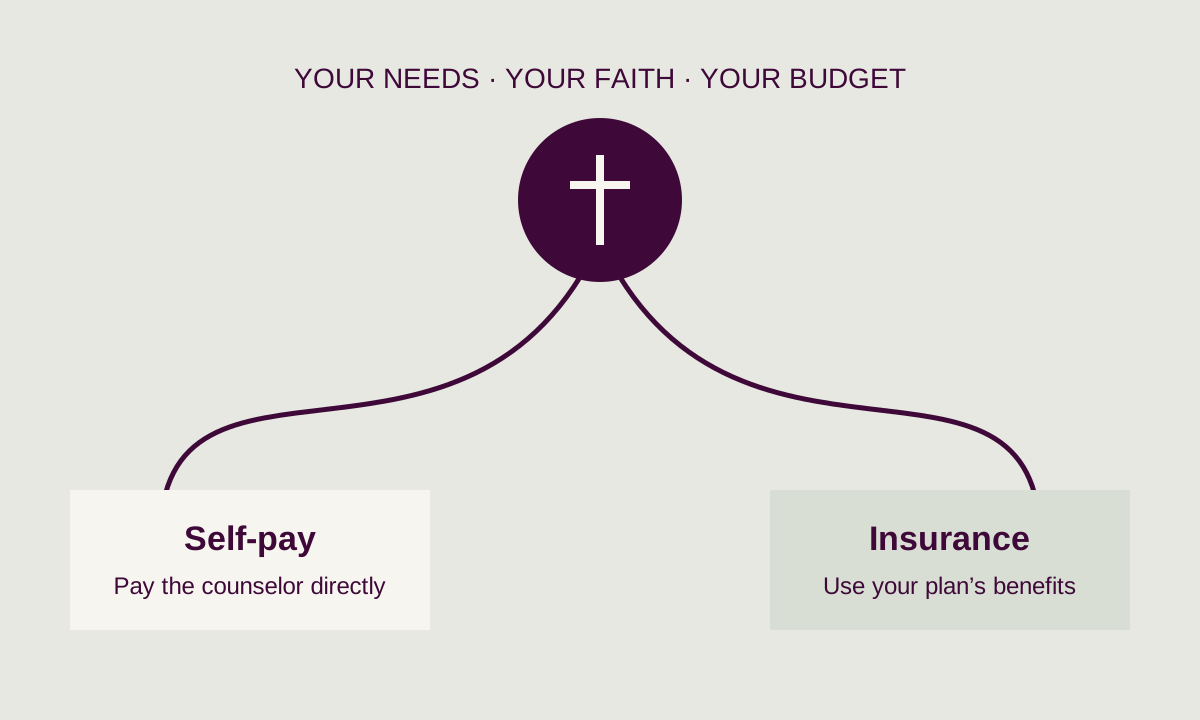
When you are ready for counseling, the payment question can feel surprisingly personal. You may want a counselor who understands your Christian faith, room to discuss spiritual concerns, and a clear sense of what each visit will cost. You may also wonder who receives information about your care when insurance is involved.
Self-pay means paying the counselor directly without asking your health plan to cover those sessions. It can offer a wider choice of providers and fewer insurance billing requirements. Insurance can make ongoing care more affordable. Neither choice determines the quality of your faith, your commitment to healing, or the value of the support you receive.
The right choice depends on your needs, your budget, the counselor, and your actual benefits. Start by reviewing the approach to counseling you want, then compare payment options against that. Here is how to think through the benefits and tradeoffs without feeling pushed toward a particular answer.
What changes when you choose self-pay?
With self-pay, you agree to the practice’s fee and pay it directly. There is no insurance claim for that visit unless you or someone acting for you later submits one. The counselor still provides professional care, maintains appropriate records, and explains fees, consent, and confidentiality.
One benefit is being able to consider counselors outside your plan’s network. A provider may have experience with the issues you want to discuss, a communication style that helps you feel at ease, or a thoughtful way of including faith. Paying directly can make that provider an option when your plan would not cover the visit.
Another benefit is clarity. A stated session fee can be easier to budget for than a charge that depends on a deductible, a claim decision, or an insurer’s allowed amount. That clarity depends on asking about the full arrangement, including the first appointment, later visits, cancellations, and any separate charges. Self-pay is straightforward only when the agreement is straightforward.
The main tradeoff is that you take responsibility for the bill. A good fit does not make an unaffordable fee sustainable. Before beginning, consider what you can comfortably continue paying, rather than what you could stretch to cover once.
Can insurance cover Christian counseling?
It can, depending on the provider, service, and plan. The phrase “Christian counseling” does not settle the coverage question. Licensed psychotherapy that includes a client’s Christian values is different from pastoral support or spiritual mentoring alone. Ask what service is being offered and how the practice handles payment.
HealthCare.gov explains that Marketplace plans include mental health services, including counseling and psychotherapy, among essential health benefits. That does not mean every counselor, service, or appointment is covered. Your plan’s network and benefit details still matter.
A Christian counselor may participate in insurance, accept self-pay, or offer more than one arrangement. Do not assume a counselor is outside your network because faith is part of the practice. Equally, a counselor’s professional license does not automatically make that person in-network for your plan.
Ask the insurer about the exact counselor, the service, and online appointments. Ask the practice to explain its own arrangements separately. Getting answers from both sides helps avoid a common misunderstanding: a provider can be willing to see you while your insurer is unwilling to pay for that visit.
A side-by-side comparison
Self-pay
- You pay the agreed practice fee.
- Choice is not limited by an insurance network.
- No claim is sent if insurance is not used.
- You carry the cost unless reimbursement is separately approved.
Insurance
- Your share depends on your benefits and claim.
- Networks may affect covered provider choices.
- Claims share billing information with the plan.
- Coverage can make regular treatment more affordable.
Both routes require an honest conversation about goals, privacy, fees, and the counselor’s qualifications. Both can support care that respects your faith. The practical question is which route allows you to receive appropriate help and keep attending without creating unmanageable stress.
More choice in how faith enters the conversation
For some people, the strongest benefit of self-pay is being able to choose a counselor for fit rather than network membership. You may want to discuss prayer, a difficult church experience, forgiveness, grief, or the gap between what you believe and how you feel. Those conversations call for trust as well as professional skill.
Self-pay may also make it easier to pursue goals that do not fit a covered mental health service, if the counselor offers appropriate support for those goals. For example, wanting space to explore spiritual questions is not the same as seeking treatment for a mental health condition. Be clear about which service you are receiving.
Insurance does not automatically prevent a counselor from discussing faith. Nor does paying directly guarantee thoughtful Christian integration. Ask how spiritual practices are used, how consent is obtained, and whether you can change your mind. A counselor’s willingness to listen to those preferences matters more than the payment label.
At Made Free For Life, Christian principles are available upon request. That means you can ask how faith might fit your work together, rather than assume every session must include prayer or Scripture. Our article on Christianity, LGBTQIA+ identity, and faith explores more questions about personal values and respectful support.
Privacy: less insurance sharing, not a promise of secrecy
When no insurance claim is submitted, that claim does not create a billing record with the insurer. Some people value this separation when discussing sensitive family, relationship, or spiritual matters. It is a reasonable preference to raise before an appointment.
However, self-pay does not erase counseling records or remove the limits of confidentiality. Practices still keep clinical and billing information. Scheduling systems, payment processors, and telehealth services may also handle information as part of providing care. Ask the counselor how these systems are used and what the practice’s privacy notice says.
HHS describes rights and protections under HIPAA for information held by covered providers and plans. These protections include limits on disclosure, but they are not a guarantee that information can never be shared. Certain permitted or legally required disclosures can still apply.
Ask about confidentiality in the situations that matter to you, including safety concerns, legal requests, and any involvement of family members or a church. You do not have to give a detailed personal history to ask who might receive information about treatment.
If you use a shared insurance plan, ask the insurer how explanations of benefits and online account access work. If you pay directly, ask what appears on receipts and payment statements. Thinking through those details before treatment can be more useful than relying on the broad word “private.”
Understanding diagnosis and medical necessity
Insurance payment for psychotherapy generally depends on the plan’s clinical and billing requirements, which commonly include a diagnosis and a reason the service is medically necessary. That is different from simply wanting time to talk with someone wise or faith-informed. Ask the counselor how assessment, documentation, and billing work.
A diagnosis can be useful. It can help identify a pattern of symptoms, guide treatment, and support access to benefits. It is not a measure of your character or spiritual strength. Needing treatment for anxiety, depression, or another condition does not mean your faith has failed.
Self-pay removes the need to submit a diagnosis to an insurer for payment when no claim is made. It does not mean the counselor skips assessment, never makes a diagnosis, or leaves clinically relevant information out of your record. A professional should describe your needs accurately regardless of how the session is paid for.
If your goals are mainly relationship growth or spiritual exploration, ask whether the proposed service is clinical treatment, another form of support, or outside that provider’s scope. Do not ask for an inaccurate diagnosis to obtain coverage. A clear explanation of the service protects you from starting with the wrong expectations.
Flexibility in goals, timing, and continuity
Self-pay can remove insurance authorization and reimbursement rules from the payment arrangement. That may simplify discussions about appointment timing or goals when the practice offers suitable options. You and the counselor can consider what makes clinical sense without making coverage approval part of every payment decision.
That flexibility still has limits. It does not promise unlimited access, longer sessions, a particular treatment, or appointments outside the counselor’s availability. It also does not mean counseling should continue indefinitely. Ask how you will review progress and decide whether the current plan remains useful.
Insurance can also support stable, effective care. Some plans have straightforward outpatient benefits, and some clients find an excellent counselor in-network. Before ruling insurance out, find out whether your actual benefits create a problem. General warnings about insurance may describe restrictions that do not apply to your situation.
Think about continuity on both sides. A change of plan could affect coverage, while a change in income could make self-pay difficult. Ask what happens if circumstances change. Having that conversation early makes it easier to discuss referrals or a different plan of care later.
Compare the cost you will actually pay
Start with the practice’s current fees. Ask whether the first visit costs the same as later visits, how long each appointment lasts, and which services have separate charges. Also ask about missed appointments and late cancellations. A lower session price is less helpful if you misunderstand the overall agreement.
Then ask your insurer about your remaining deductible, any copayment or coinsurance, and the provider’s network status. A deductible is an amount you may need to pay before certain benefits begin. A copayment is usually a set amount; coinsurance is a share of a covered charge. Your own plan explains how these apply.
Compare the same kind of appointment on both sides. An introductory consultation, a full assessment, and an ongoing therapy session may have different fees or coverage. Ask whether the quoted insurance amount is an estimate or a confirmed claim result, and keep a note of who supplied it.
Look beyond one visit. Consider the likely schedule discussed with the counselor, then work out what a month of care could cost under each arrangement. This is a planning exercise, not a commitment to a fixed number of sessions. Revisit it when your goals or circumstances change.
Self-pay is not automatically cheaper than using a high-deductible plan, and insurance is not automatically cheaper for every appointment. Ask whether a direct payment counts toward your plan’s deductible or out-of-pocket limit; do not assume it will. The useful comparison is the cost you can verify, alongside the care you can realistically sustain.
Ask for a Good Faith Estimate
Written cost information can reduce uncertainty when you are not using insurance. CMS explains Good Faith Estimates for uninsured and self-pay patients. In general, providers must offer an estimate when requested or when eligible care is scheduled at least three business days ahead.
Ask what the estimate includes, how it describes ongoing appointments, and when it would need to change. An estimate helps you understand expected charges; it is not a promise about exactly how many sessions you will need. Keep it with your appointment and billing information so you can compare it with later charges.
If a bill is at least $400 above the estimate from a provider, a federal dispute process may be available. CMS explains eligibility and deadlines. Asking for clear costs is a normal part of planning for care, and you can raise billing questions without sharing the personal issues you hope to discuss in treatment.
What about out-of-network reimbursement?
Some people pay a counselor directly, then seek partial reimbursement through out-of-network benefits. If the practice provides a suitable itemized document, often called a superbill, it may help you submit a claim. Neither having a superbill nor having out-of-network benefits guarantees payment.
Check your plan before relying on reimbursement. Ask whether the provider and service qualify, whether a separate deductible applies, how the allowed amount is calculated, and what documents are required. Also ask about claim deadlines. Budget for the possibility that the insurer pays less than you expect or denies the claim.
Submitting a claim also changes the privacy picture. You are asking the plan to review information about the service, rather than keeping it outside insurance billing. If avoiding insurer involvement is a main reason for paying directly, discuss that tradeoff before requesting or submitting paperwork.
This article does not confirm Made Free For Life’s insurance participation, fees, or availability of superbills. Contact Ed about current payment arrangements so you can make plans from the practice’s actual information.
When insurance may be the better fit
Insurance deserves serious consideration if it gives you access to a qualified counselor at a cost you can manage. Regular attendance can matter more than having a wider list of providers you cannot afford. There is no need to treat self-pay as the more committed or more faithful choice.
You may find an in-network counselor who is comfortable discussing Christian values and has the experience you need. Ask the same questions about faith, professional training, consent, and goals that you would ask a private-pay provider. Payment arrangements do not replace a careful conversation about fit.
If a claim is denied or coverage seems unclear, ask the plan for a written explanation and its review or appeal process. Avoid assuming you must immediately abandon a useful treatment relationship. The practice may be able to clarify billing information, although it cannot promise that an insurer will change its decision.
If neither route feels affordable, say so. Ask about reduced fees, community resources, or referrals. Made Free For Life’s frequently asked questions explain that a reduced-fee option may be available or Ed may be able to suggest lower-cost support. Availability should be confirmed directly.
Questions to ask before you decide
You can begin with a short message: “I am considering counseling and would like to understand your fees, insurance arrangements, and how Christian principles can be included.” You do not have to describe sensitive experiences in an initial inquiry. A practical first conversation is a valid place to start.
When speaking with the practice, ask what happens if you need to change the payment arrangement after starting. When speaking with the insurer, identify the exact provider and service rather than asking only whether “therapy” is covered. Keep the responses together so you can compare them without relying on memory.
Give yourself room to think after the answers arrive. A clear payment agreement should leave you understanding your responsibilities, not feeling pressured to book before you are ready. It is reasonable to ask for an explanation in writing when a detail remains unclear.
Starting with Made Free For Life
Made Free For Life offers professional counseling for mental health, relationship, and recovery concerns, with Christian principles available upon request. Explore the areas of care to consider whether the support matches what you are seeking.
Online telehealth services are available in WA and FL. You can reach out to Ed to discuss your needs, ask about current fees and payment arrangements, and learn how faith could fit your counseling. The aim is a clear starting point: appropriate support, informed choices, and an arrangement you understand.
Frequently asked questions
Is self-pay better than insurance for Christian counseling?
Self-pay may be a better fit when choosing a particular counselor, avoiding insurance claims, or pursuing goals outside covered treatment matters most to you. Insurance may be better when it makes appropriate care affordable. Compare the counselor’s qualifications, your actual benefits, and the full fee arrangement. A payment method does not tell you whether a counselor will respect your beliefs or provide helpful care.
Does using insurance mean I cannot talk about God or prayer?
No. Using insurance does not automatically rule out discussing faith in professional treatment. Coverage depends on the service, provider, and plan requirements. Ask the counselor how Christian principles are included and how your preferences shape that process. Pastoral support alone is a different service from licensed psychotherapy. You should understand which kind of care you are receiving before making assumptions about coverage or the content of sessions.
Will self-pay keep counseling completely off the record?
No. A counselor still keeps appropriate records, and confidentiality has limits. If no insurance claim is submitted, there is no claim from that visit for the insurer to process. However, records may still be used or disclosed in permitted or legally required circumstances. Ask about the practice’s privacy notice, billing systems, and confidentiality limits. Paying directly is a payment choice, not a guarantee that no record exists or can ever be shared.
Does self-pay mean I will never receive a diagnosis?
No. Professional assessment and documentation still apply when you pay directly. A counselor may identify and record a diagnosis when clinically appropriate. What changes is that no diagnosis needs to be submitted to an insurer for payment when no claim is made. Ask how your needs will be assessed and recorded. An accurate diagnosis can guide care, and it should not be treated as a judgment about your faith or worth.
Can I get reimbursed after paying for counseling myself?
Possibly, if your plan has applicable out-of-network benefits and the provider and service meet its rules. Ask the insurer what it needs before assuming reimbursement will be available. A practice may or may not provide a superbill, and receiving one does not guarantee payment. Submitting a claim also shares billing information with your plan. Consider both the potential financial benefit and the information involved before choosing that route.
What if I cannot afford the self-pay fee?
Tell the practice that cost is a concern before committing to care. Ask about reduced-fee availability, suitable referrals, or community services, and compare any usable insurance benefits. Made Free For Life notes that reduced-fee support may be available or Ed may be able to suggest a lower-cost organization. Confirm current options directly. You do not need to choose an arrangement that puts basic expenses at risk to show that you take counseling seriously.
Does Made Free For Life accept my insurance?
Ask Ed directly about the practice’s current payment arrangements and check any proposed coverage with your plan. This article explains general differences rather than confirming participation with a particular insurer, a specific fee, or reimbursement eligibility. Have the exact provider and service details ready when you speak with the insurer. Getting clear answers before the first appointment helps you decide whether the arrangement fits both your counseling goals and your budget.
